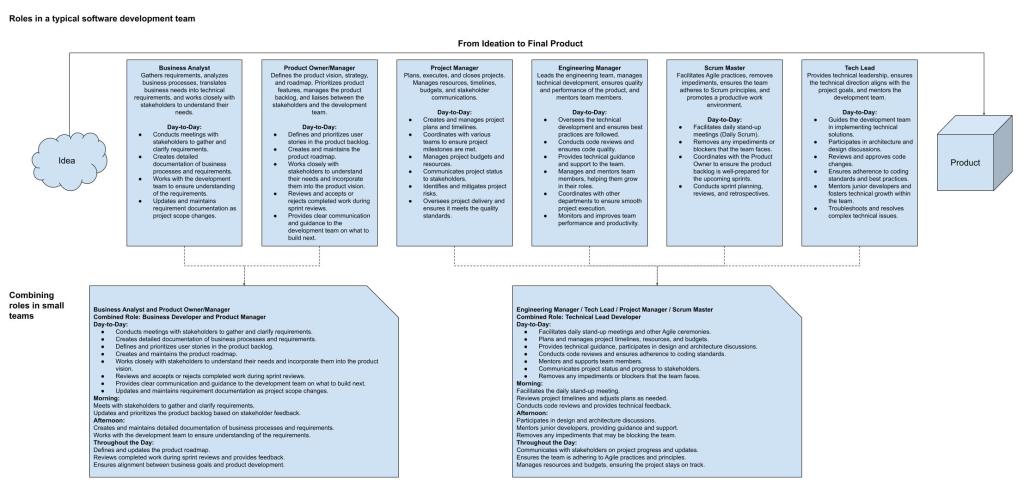
In the world of software development, certain roles are essential to ensure the smooth running of projects, high-quality product delivery, and effective team management. These roles include the Scrum Master, Business Analyst, Product Owner/Manager, Project Manager, Engineering Manager, and Tech Lead. These positions are standard across the industry, with each contributing unique skills and responsibilities that drive project success. However, the size of a team and the nature of a company can significantly influence how these roles are filled and managed.
Typical Roles in a Software Development Team
- Scrum Master: Facilitates Agile practices, removes impediments, and ensures adherence to Scrum principles.
- Business Analyst: Gathers and analyzes requirements, translates business needs into technical specifications, and documents business processes.
- Product Owner/Manager: Defines the product vision, strategy, and roadmap, prioritizes features, and manages the product backlog.
- Project Manager: Plans, executes, and closes projects, manages resources, timelines, budgets, and stakeholder communications.
- Engineering Manager: Leads the engineering team, manages technical development, ensures quality and performance, and mentors team members.
- Tech Lead: Provides technical leadership, ensures the technical direction aligns with project goals, and mentors the development team.
Combining Roles in Small Teams
In smaller teams, it is often necessary to combine roles to ensure efficiency and make the best use of limited resources. For instance, a single individual might take on the responsibilities of an Engineering Manager, Tech Lead, Project Manager, and Scrum Master. Similarly, another person might fulfill the duties of both a Business Analyst and a Product Owner/Manager.
Combined Roles in a Very Small Team
- Technical Project Lead (Engineering Manager / Tech Lead / Project Manager / Scrum Master)
- Responsibilities: Oversees technical quality and performance, guides the development team, manages project timelines and resources, facilitates Agile practices, and removes impediments.
- Day-to-Day: Facilitates daily stand-ups, reviews project timelines, participates in design discussions, conducts code reviews, mentors team members, and communicates project status to stakeholders.
- Product Business Manager (Business Analyst / Product Owner/Manager)
- Responsibilities: Gathers and analyzes requirements, defines the product vision and roadmap, prioritizes the product backlog, and liaises between stakeholders and the development team.
- Day-to-Day: Meets with stakeholders, updates and prioritizes the product backlog, documents business processes, works with the development team to ensure requirement understanding, and reviews completed work.
Product-Based Companies vs. Consulting Firms
Product-Based Companies
In a product-based company, where a single product is owned and developed by the company, the roles of Product Owner/Manager and Engineering Manager are particularly critical. The Product Owner/Manager ensures that the product evolves according to market needs and business objectives, while the Engineering Manager maintains the technical quality and performance of the product. The Scrum Master is also crucial for maintaining Agile processes and ensuring continuous delivery and improvement of the product.
Consulting Firms
In consulting firms, which handle multiple products, clients, and projects, the roles of Project Manager and Business Analyst are extremely relevant. Project Managers need to manage diverse projects, coordinating resources and timelines across different clients. Business Analysts must quickly understand and document varying business requirements for different clients, ensuring that each project meets the client’s specific needs. The Scrum Master’s role, while still important, may vary in relevance depending on the client’s processes.
Rationale for Combining Roles
Combining roles in small teams is often driven by the need to optimize resources and ensure efficiency. By merging responsibilities, small teams can maintain high standards of productivity and quality without being overwhelmed by the workload. However, it’s essential to ensure that the combined roles are manageable and that the individuals taking on these roles have the necessary skills and experience to handle the broader scope of responsibilities.
In summary, while the typical roles in a software development team are standard across the industry, their implementation can vary significantly based on the team size and the nature of the company. Understanding how to effectively combine these roles in small teams, especially in the context of product-based companies versus consulting firms, can lead to more efficient and successful project outcomes. By strategically managing roles and responsibilities, even the smallest teams can achieve great success in software development.

 Ali Bahaloo